Sub-Zero wine storage repair
Wine storage units and dual-zone cabinets, where stability matters more than raw cooling and humidity is half the specification.
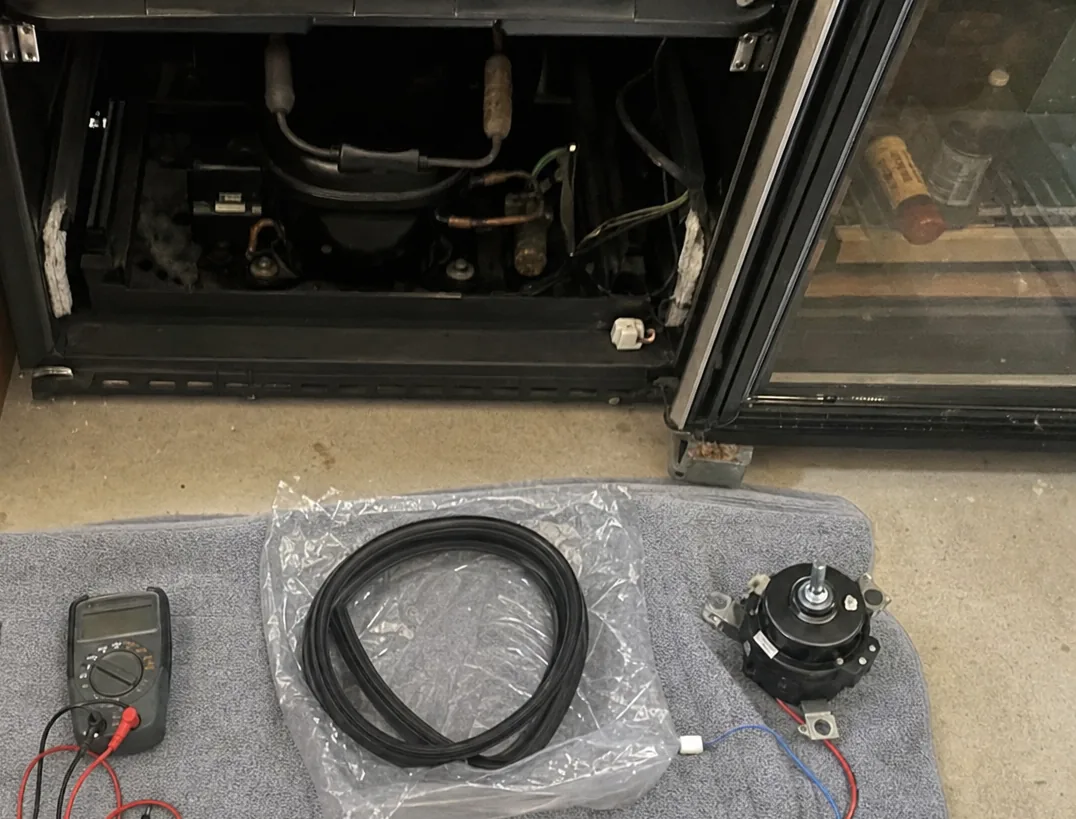
What people call about
- Upper and lower zones drift toward each other
- Condensation forming on the inside of the glass door
- Cabinet cools but the humidity feels wrong
- Compressor cycles far more often than it used to
- Shelf rails or fasteners showing rust bloom
Symptoms, not fault codes. We read the machine in front of us rather than guessing from a list.
A wine cabinet has a different job from a refrigerator. A refrigerator has to get cold. A wine cabinet has to be boring: the same temperature this week as last week, the same humidity, no light, no vibration. Wine is damaged by change far more than by any single number, so a unit that swings four degrees twice a day is failing even though it never once ran warm.
That is why we diagnose these cabinets with a logging probe rather than a snapshot reading. A spot check of a wine cabinet tells you almost nothing.
Zone drift
Dual-zone cabinets hold a cooler zone for whites and sparkling and a warmer zone for reds, usually a serving-temperature spread rather than two entirely independent climates. When the two zones start converging, the cause is almost always one of three things: a damper or airflow path that is not modulating, a sensor that has drifted, or a door seal that is letting the warmer zone recruit room air.
Order matters. We verify the sensors against an independent probe in the same air first, because a control acting on a wrong reading behaves identically to a failed control, and the parts cost is not remotely the same.
Glass doors on a barrier island
A glass door is a thermal weak point by definition, and this climate presses on it hard. Interior condensation on the glass means the inner pane is dropping below the dew point of the air in front of it. In a Jacksonville Beach house with the doors open on a spring afternoon and the indoor humidity running high, that can happen to a cabinet that is otherwise working correctly.
Before we condemn a door we check the room. Where the cabinet sits, what the ambient humidity is at the cabinet face, whether it is in line with a slider or a hallway that opens to a screened porch. A wine cabinet installed on an exterior wall of a beach house sees a different environment from one in an interior butler’s pantry twenty feet away, and the fix is sometimes placement or a door-seal set rather than a component.
If the seal genuinely has lost its set, or the door hinge has taken enough corrosion to sit a fraction out of plane, then we replace hardware. Hinge corrosion is common here and it is worth checking annually on any cabinet with a heavy glass or panelled door.
Humidity, corks and the thing people get wrong
Wine storage is usually specified around a moderate relative humidity — enough that corks do not dry and shrink, not so much that labels foul and mould appears on the underside of a shelf. A cabinet that is cooling correctly but running dry will show it in the corks long before anything else, and in a collection meant for years rather than months that matters more than the last degree of temperature accuracy.
The frequent misdiagnosis is treating low humidity as a refrigeration fault. It often is not. Excess air exchange — a door being opened constantly, a seal breathing, a cabinet in a room with aggressive conditioning — pulls moisture out faster than the cabinet can return it. That is an airflow problem with a humidity symptom.
Vibration and where the cabinet stands
Compressor vibration transmitted into racking is a genuine issue in a cabinet holding bottles for years. On this island there is a second source people overlook: a unit that is not level because it sits on an older beach cottage floor with some spring in it. A cabinet slightly off level runs its compressor harder on one side of the mount and passes more of that energy into the frame. We check level and mounting on every visit, and it takes two minutes.
Corrosion, because everything here comes back to it
Wine cabinets are usually installed away from the kitchen — a bar, a pantry, a converted closet. Those spaces get less air movement and less attention, and salt-laden air that gets into the house settles there just the same. Rust bloom on shelf rails and fasteners is the early signal. Look there before you look at the coil, because the coil is harder to see and it is telling the same story.
We give you a written finding with the logged temperature trace, a written estimate before any part is ordered, and genuine OEM parts. We are independent, EPA Section 608 certified for refrigerant handling, and we service Sub-Zero refrigeration only.
How the visit runs
- Diagnostic, $80 flat. Flat $80 diagnostic. It is credited toward the repair if you go ahead with the work.
- Written finding. What is wrong, what caused it, and what the cabinet will do if it is left alone.
- Written estimate. You get a written estimate before any part is ordered or any labor is billed.
- Repair. Genuine OEM parts, and the condenser cleaned before we leave whether or not it was the fault.
Updated August 15, 2026. See pricing and warranty for the full terms.
What does wine storage repair cost?
Flat $80 diagnostic covering the visit and the full diagnostic sequence, credited toward the repair once you approve the work.
| Work | Typical range |
|---|---|
| Diagnostic visit | $80 flat, credited |
| Compressor or sealed-system repair | $920–$2,380 |
| Door gasket or seal replacement | $230–$630 |
Ranges, not quotes. What a cabinet actually needs is settled by readings taken with the grille off, and the figure you are asked to approve is written down before a part is ordered. The whole table is on the pricing page.
Why are the two zones drifting toward each other?
- Because whatever separates them has stopped working: a damper, a second evaporator or the fan that feeds one of them. A cabinet that cools as a single box has lost the thing you bought it for, and the fix is usually in the air path rather than in the refrigerant.
Is condensation on the inside of the glass normal?
- Not normal, but not mysterious either. Glass is the coldest surface in the cabinet, and in a house on the water the air arriving at it is carrying more moisture than the cabinet was designed around. We check the seal and the door heater first, then where the cabinet is standing.
Does humidity really matter, or is that marketing?
- It matters, for corks rather than for wine. Air that is too dry shrinks a cork and lets the bottle breathe, which is the one failure you cannot undo. When humidity collapses in one of these cabinets the cause is usually a blocked drain path or a seal riding on worn hardware.