Salt, lint and why beach condensers foul early
A field note on reading condenser fins for salt loading before any cooling complaint shows up.
Published August 15, 2026
Fins tell you the history of a machine before the thermometer does. On a barrier island they tell it early, and they tell it in a particular order: the leading edge of the fin pack, then the fastener heads, then the hinge pins.
Learn to read those three and you will know what shape a cabinet is in without taking a single temperature.
What is actually landing on the coil
Breaking surf throws a fine aerosol into the air — chloride in solution, in droplets too small to see or feel. The onshore breeze carries it inland. It settles on windshields, on rail hardware, on the edges of a stainless panel that has gone dull while the centre still looks new.
Your condenser fan pulls that air through the fin pack deliberately. Moving room air across the coil is the whole job. There is no version of a working refrigerator that does not do this, which is why the marine environment is not something you can seal a cabinet against.
Salt on its own would be a cosmetic problem. Two properties make it a service problem.
First, it is hygroscopic: it draws moisture out of humid air and holds a damp film on whatever it has landed on. Second, that film is an electrolyte, and an aluminium fin bonded to a copper tube is a pair of dissimilar metals waiting for one.
The felt, and why a vacuum will not touch it
Inland, a neglected condenser collects a dry mat of lint and pet hair. You can lift it away in one piece. It is unsightly and it costs efficiency, and it comes off.
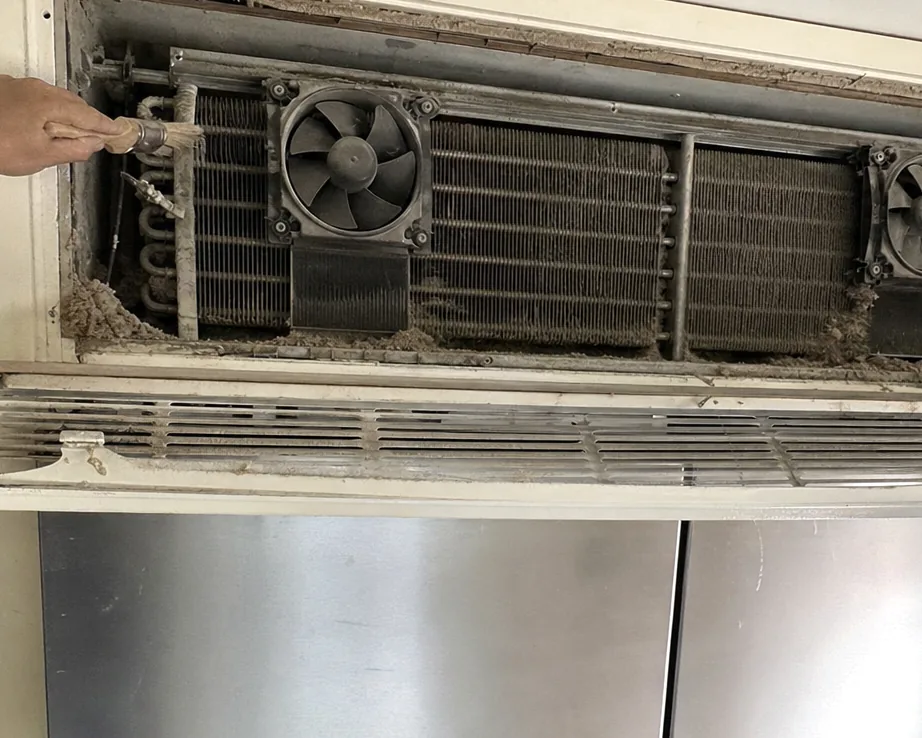
Here, that same lint lands on a damp salt film and bonds to it. What you end up with is closer to felt than to dust. A vacuum nozzle skates over the surface and takes the top layer. The layer that matters — the one in contact with the metal, holding moisture against it around the clock — stays exactly where it is.
This is why homeowners on these blocks tell us they clean the coil every year and are surprised to be shown what is under it. They did clean it. They cleaned what was accessible with the tool they had.
Reading the leading edge
Air enters the fin pack from one side. That side takes the deposit first and heaviest, so it is where you look.
Bright or lightly grey metal is a coil doing fine.
A dull, even grey film is normal for this coast. It cleans off.
White powder that comes away on a fingertip is aluminium corrosion product. The fin is giving up material. That surface area does not come back after cleaning, so this is the point at which the cleaning interval should already have been shortened.
Fins that look thin, ragged or crumbly at the edge mean it has been going on for years. The coil still works — it just works with less surface than it was designed to have, and every hot week costs the cabinet more than it used to.
Then the fasteners, then the hinges
Corrosion at the fin pack tells you about deposit. Corrosion at steel fasteners tells you about moisture. Rust bleeding from a screw head inside a machine compartment means that compartment has been running damp, and a damp compartment usually means restricted airflow, because a coil that is breathing properly also dries.
Hinge pins are the last check and the most useful one on a door-heavy cabinet. A stiff hinge is not a nuisance; it is a door that will eventually sit a fraction low, seal on three sides, and load the cabinet with humid air until somebody notices frost building on one side of the freezer.
That is the chain we see constantly on the beaches. A corrosion problem, two steps downstream, presenting as a temperature complaint.
What to do about it
Shorten the interval, not the effort. Within a few blocks of the ocean, plan on cleaning three or four times a year. A mile back, twice. Clean along the fin direction with a soft brush and a vacuum with real suction. No pressure washer, no garden hose, no wire brush, no compressed air driving debris deeper into the pack.
And photograph the coil each time. A year-on-year comparison of the leading edge is the only honest way to know whether your interval is right for your address.
What does the repair behind this note cost?
Flat $80 diagnostic covering the visit and the full diagnostic sequence, credited toward the repair once you approve the work.
| Work | Typical range |
|---|---|
| Diagnostic visit | $80 flat, credited |
| Evaporator or condenser fan motor | $270–$590 |
Ranges, not quotes. What a cabinet actually needs is settled by readings taken with the grille off, and the figure you are asked to approve is written down before a part is ordered. The whole table is on the pricing page.
How do I tell salt loading from ordinary dust?
- By how it behaves rather than how it looks. Ordinary dust lifts. A salt-bound mat holds damp, sits as felt between the fins and stays put under a vacuum nozzle, and the leading edge of the coil greys first while the rest still looks presentable.
What does white or green powder on the fin edges mean?
- That corrosion is already under way: the white is aluminium corrosion product and the green is on the copper side of things. Neither is a reason to panic, both are a reason to get the cleaning interval right and to look at the fasteners and hinges while the panel is off.